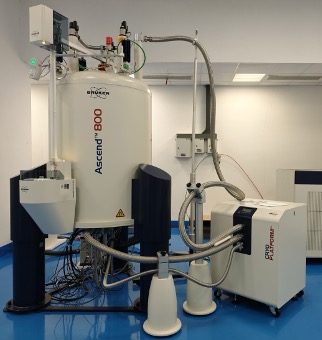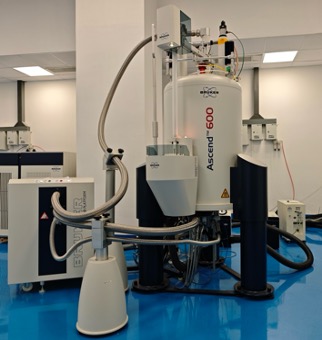

The NMR Core of the iHuman Institute at ShanghaiTech University, established in 2016, is dedicated to supporting frontier research in the life sciences and chemistry. Centered on solution nuclear magnetic resonance (NMR) spectroscopy, the Core focuses on key scientific questions including three-dimensional structure determination of biomacromolecules in solution, structure–function relationships, molecular dynamics, biomolecular interactions, and the recognition and binding processes between biomacromolecules and small molecules.
Instrumentation and Core Hardware
The Core is equipped with 800 MHz and 600 MHz solution NMR spectrometers, both fitted with 1H/19F-13C-15N triple-resonance cryogenic probes. These systems provide high sensitivity and spectral resolution, supporting multidimensional NMR experiments across a wide range of samples, from small organic molecules to complex biomacromolecules.
Experimental Capabilities and Technical Scope
Routine analysis of organic molecules: one-dimensional (1H, 13C, 19F, 15N) and two-dimensional experiments (COSY, TOCSY, HSQC, HMBC, NOESY, etc.) for structural identification and quantitative analysis;
Multidimensional NMR of biomacromolecules: protein three-dimensional structure determination, measurement of dynamic parameters (T₁/T₂ relaxation, NOE), and studies of protein–ligand and protein–protein interactions, with applications in drug screening;
Advanced 19F NMR techniques: the Core has established a systematic suite of 19F -based NMR methodologies, enabling studies of conformational dynamics, ligand binding, and functional mechanisms of membrane proteins—particularly G protein-coupled receptors (GPCRs)—and providing a powerful tool for drug discovery and mechanistic investigations.